


Unlike most common food products, green coffee is a commodity with prices that fluctuate daily. Consequently, for businesses, procurement is a strategic game of timing. To help our partners navigate market waves proactively, this article from MeTrang Export analyses the four core factors that dictate the coffee beans price.
The global mechanism behind the coffee beans price
A clear grasp of how the price is formed allows your business to remain calm amidst market volatility, empowering your brand to make procurement decisions with confidence and precision.
Standard measurement units affecting the coffee beans price
In the coffee industry, aligning measurement units is the foundational step in controlling cash flow and inventory volume when tracking the coffee beans price. Similar principles are discussed in MeTrang Export’s guide on coffee beans wholesale optimization, where procurement efficiency is analyzed beyond simple unit pricing:
- Exchange benchmarks: Arabica prices are quoted in US cents/lb, whereas Robusta is calculated in USD/ton (1 ton = 2204.62 lbs).
- Net weight: This represents the actual weight of the coffee beans after deducting packaging. This figure is vital for calculating precise input costs for production.
- Gross weight: This includes both the coffee beans and the packaging (jute bags about 600g – 1kg).
- Moisture convention: Weights are usually established at a standard 12.5% moisture level. If the actual moisture is lower, your business effectively receives more beans per weight unit.


Distinguishing local vs. Export coffee beans price
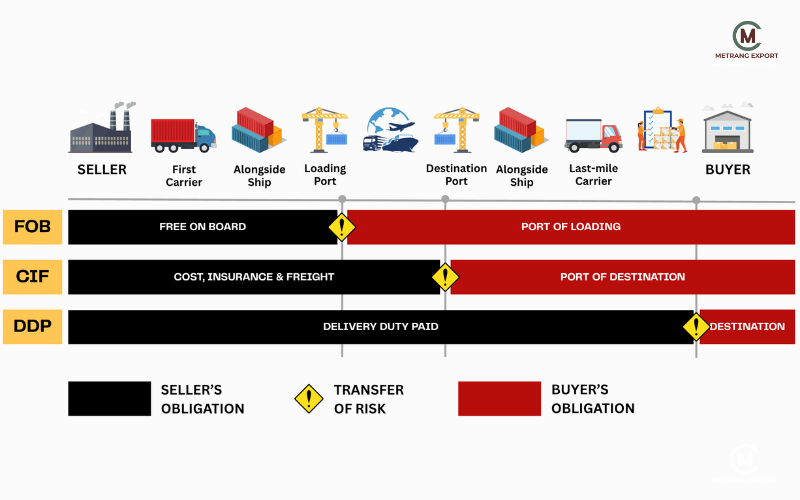
The discrepancy between local and export prices reflects value-added services and specific shipping terms. For businesses sourcing directly from origin, understanding the advantages of buying green coffee beans from Buon Ma Thuot can provide additional cost transparency and supply chain stability. Generally, coffee beans price is quoted by suppliers following standard Incoterms:
- Ex-works (EXW): The price at the supplier’s warehouse or the farm. This does not include transportation, export-standard packaging, or legal export formalities.
- FOB (Free On Board): The price at the port of departure. This includes the local price plus processing, inland freight, terminal charges, and all customs duties. The supplier’s liability ends once the cargo is safely loaded onto the vessel.
- CIF (Cost, Insurance, and Freight): This price includes the FOB value plus marine insurance and ocean freight to deliver the goods to your business’s destination port.
- The differential: This is the most volatile element, reflecting the specific bean quality and origin reputation compared to the listed prices on the London or New York exchanges.
How supply and demand dynamics influence the coffee beans price
The law of supply and demand serves as the compass for price movements in any commodity market. For roasters, analyzing these dynamics involves forecasting potential breaking points within the global supply chain that could impact the coffee beans price.
H3: The impact of weather patterns on the coffee beans price
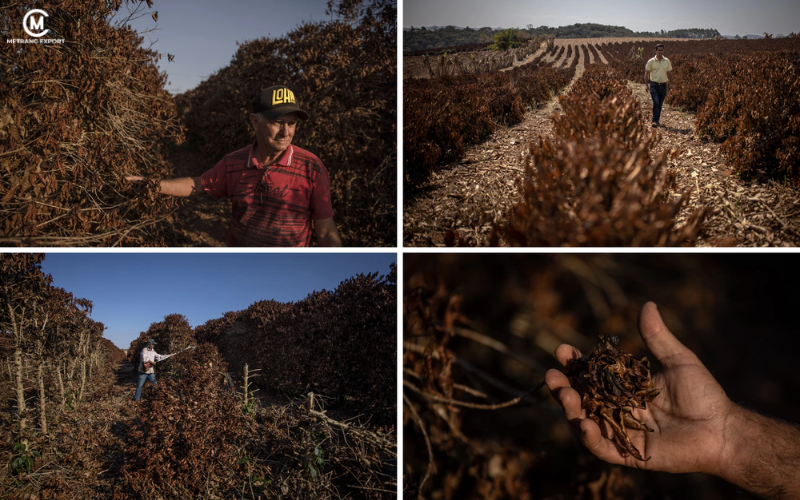
Weather remains the most significant risk variable, as it directly dictates both yield and bean quality. The relationship between climate conditions and bean development is particularly evident in Robusta green coffee production, where environmental factors strongly influence cup quality and yield. Extreme climate events often trigger aggressive volatility in the coffee beans price.
- El Niño and La Niña: In Vietnam, prolonged droughts caused by El Niño can slash Robusta production by 10-15% in a single season. When supply from the world’s top Robusta exporter tightens, the local coffee beans price tends to decouple from the London exchange and remain at peak levels. This highlights why Vietnamese Robusta remains a strategic advantage for global coffee buyers.
- Frost in Brazil: As Brazil contributes roughly one-third of global output, a sudden frost in Minas Gerais can cause the New York exchange to skyrocket by 20-30% within just a few trading sessions.
- Rainfall and humidity: Heavy rainfall during harvest not only reduces yield but also disrupts the drying process. As export-grade beans (Grade 1, S18) become scarce, the price differential is pushed significantly higher.
Global consumption trends driving the coffee beans price
Rising global demand places immense pressure on world reserves, steadily pushing up the coffee beans price:
- Emerging markets: Double-digit growth in China and Southeast Asia reduces international supply as exporting nations consume more domestically.
- Quality shifts: The surge in Specialty coffee (80+ Cupping scores) has established a premium pricing segment, independent of standard market grades.
- Low stock levels: Record-low inventories at major ports signal a bullish trend. MeTrang Export monitors ICO data to help your brand optimize procurement timing before demand exceeds supply.
How financial exchanges regulate the coffee beans price
Coffee is listed on major derivative exchanges due to its high liquidity and significant seasonal risks.
How London and New York exchanges set the coffee beans price
The London and New York exchanges establish transparent global benchmarks and provide critical Hedging tools for both producers and buyers to mitigate market volatility.
| Comparison criteria | ICE Futures US (New York) | ICE Futures Europe (London) |
| Commodity | Arabica | Robusta |
| Unit | US cent/lbs | USD/ton |
| Contract size | 37,500 lbs (approx. 17 tons) | 10 tons |
| Market impact | The benchmark for Specialty coffee segments | Direct impact on Vietnam’s coffee beans price |
The coffee beans price is formed through the constant tug-of-war between Bid and Ask orders from millions of global participants, reflecting future supply and demand expectations.
The influence of exchange rates and speculation on the coffee beans price
As a traded asset, the coffee beans price is heavily influenced by speculative capital and currency shifts:
- Currency volatility (USD/VND): Since coffee is priced in USD, your business may face a higher coffee beans price in local currency if the USD strengthens, even if global market prices remain flat.
- Speculation: Financial hedge funds often inject massive capital to profit from price spreads. Large-scale long positions can cause the coffee beans price to skyrocket, even without an actual physical shortage at the origins.
- Market sentiment: News regarding inflation and interest rates dictates capital flow in and out of the coffee market. Buyers must distinguish between real rallies caused by shortages and artificial waves driven by speculation.
MeTrang Export advises partners to look beyond the physical beans. We help you monitor the US Dollar Index (DXY) and Commitment of Traders (COT) reports to navigate market reversals effectively.
Bean quality – The ultimate deciding factor of the coffee beans price
While international exchanges provide a baseline reference, the physical quality of each lot is the final factors that determine the coffee beans price on a contract.
How grading standards shape the coffee beans price
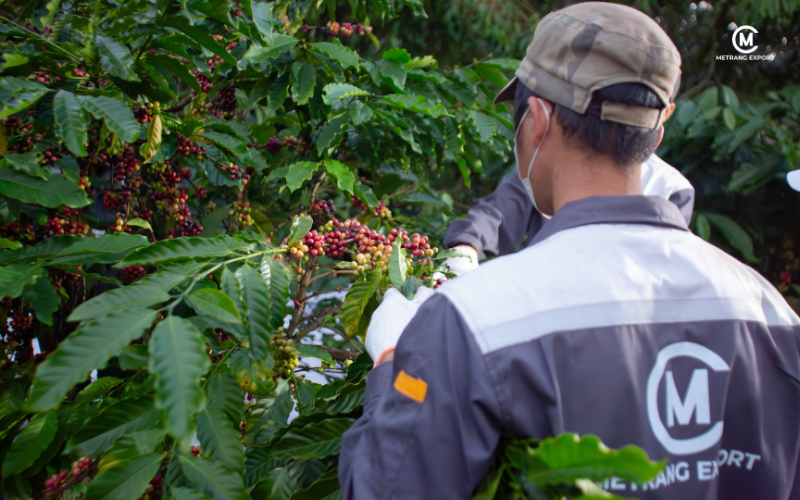
Grading systems based on screen size and defect rates are the most standard measures of commercial value. Lots meticulously processed through color sorters and stone removers eliminate risks of black, broken beans, or impurities. Effective green coffee processing and quality control is essential for maintaining this consistency. High uniformity allows businesses to maintain stable roasting profiles and minimize dry weight loss. Consequently, the finished coffee beans price accurately reflects the supplier’s technological expertise and refining efforts.
Value added from processing methods and international certifications
Processing techniques and sustainability certifications are key drivers that increase the surplus value of the coffee beans price.
- Advanced processing: Complex methods like Honey processing or Anaerobic fermentation often command higher prices than traditional washed/natural processes due to their unique flavor profiles.
- Sustainability labels: International certifications such as 4C, Rainforest Alliance, or Fairtrade serve as guarantees for ethical and sustainable farming practices, justifying a premium price segment.
Conclusion
Managing the coffee beans price blends financial acumen with technical expertise. Instead of predicting the market, businesses should build strategic ties with transparent, risk-capable suppliers. MeTrang Export provides daily market updates to help your brand make well-timed procurement decisions, optimizing costs for sustainable profit.